Booking choice: The Last Walk and VR Annex tour, from $49 per person. Check dates Tour details
The Secret Annex is the rear part of the building at Prinsengracht 263, where Otto Frank ran his business. From 6 July 1942 to 4 August 1944 it was the hiding place of the Frank family, the Van Pels family and Fritz Pfeffer. Anne Frank wrote her diary there. Today the building is the Anne Frank House museum.
Everything on this page comes from the Anne Frank House and the Anne Frank Fonds, with a few secondary sources named where we use them. We keep to what is known. Where the record is silent, we say so.
The quick answer
The Secret Annex is the back house of Prinsengracht 263, Amsterdam. Eight Jewish people hid there for 761 days, from 6 July 1942 until the police arrested them on 4 August 1944, supported by six helpers from Otto Frank's company. Only Otto survived. Anne's diary was saved by two of the helpers, and the Annex is still standing, empty at Otto's wish, as part of the museum.
What is the Secret Annex?
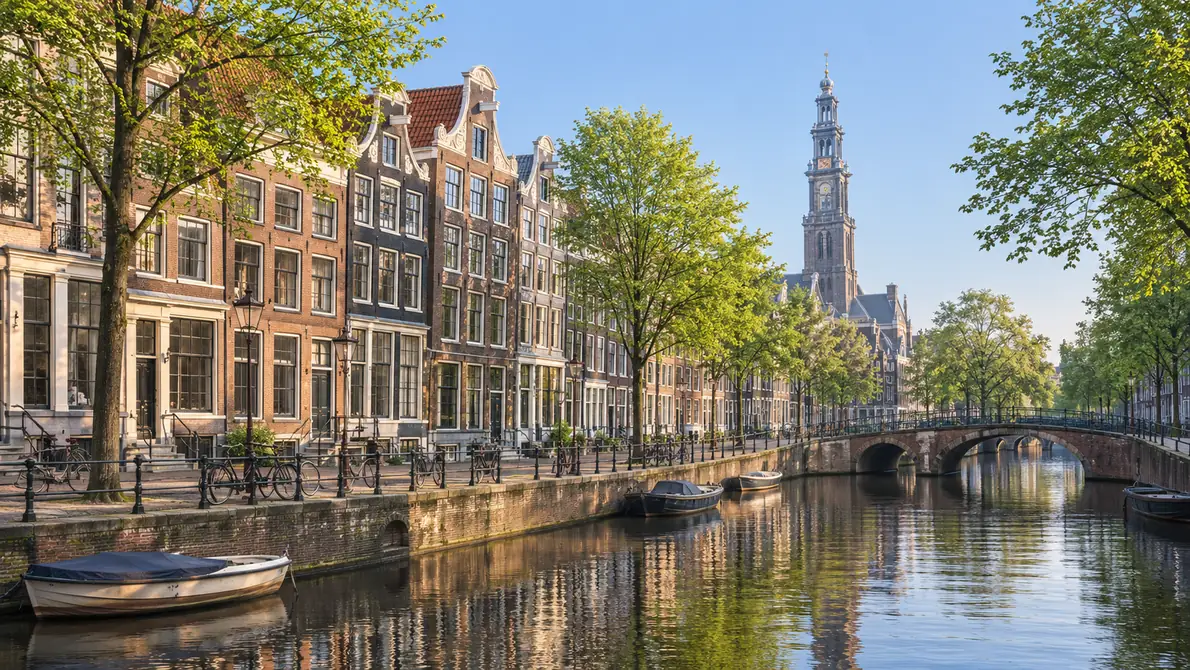
The rear part of the business premises at Prinsengracht 263, behind a bookcase on the landing. The house dates from 1635; the annex from 1739.
The building was a private house next to two warehouses in the 17th century. In 1940 Otto Frank's companies, Opekta, which sold pectin for making jam, and Pectacon, which traded in herbs and spices, moved in: a workshop and warehouse on the ground floor, offices and storage above. The eight people in hiding lived on the top floors of the annex at the back, out of sight of the street.
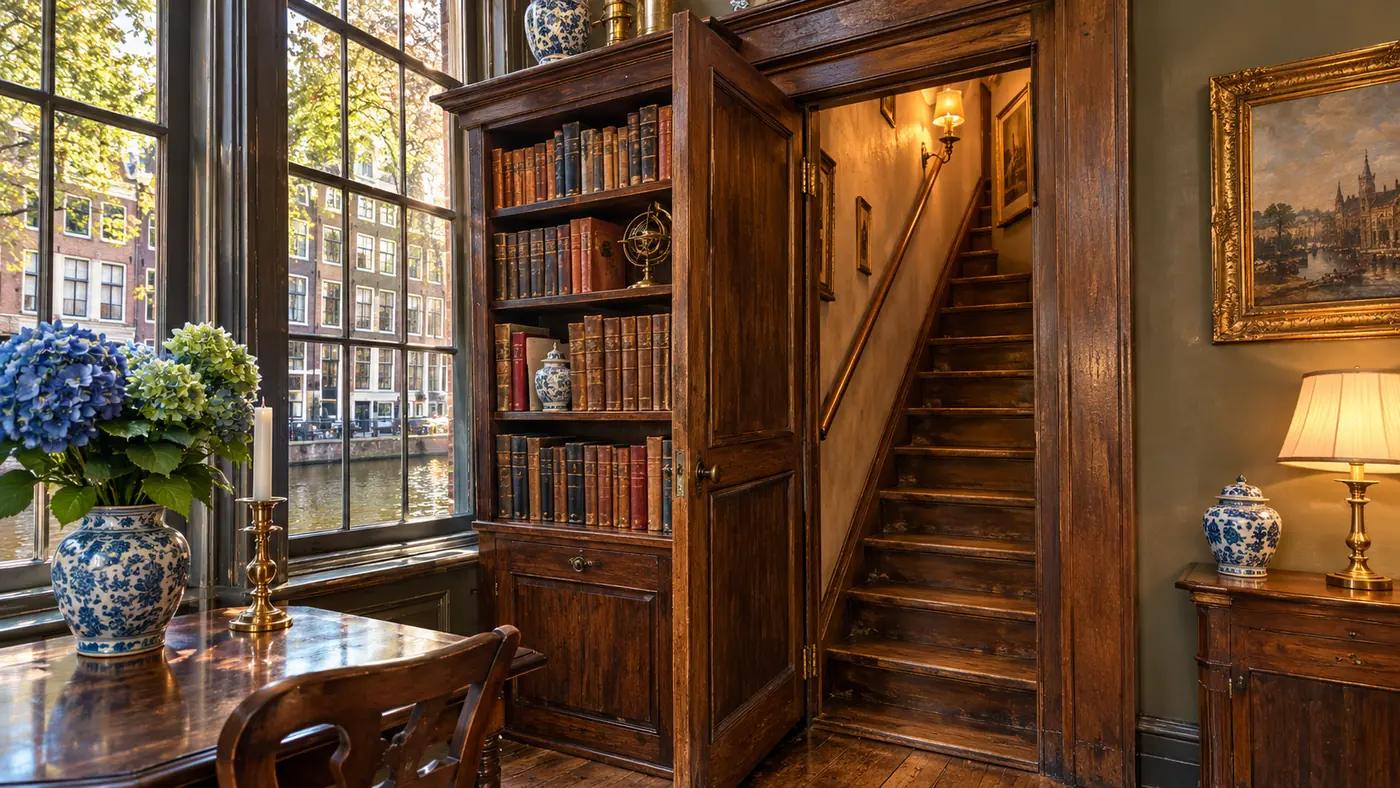
The entrance was disguised by a hinged bookcase. The Anne Frank House explains that the idea came from Victor Kugler, who thought a cupboard in front of the door would be safer, and that Johan Voskuijl built it; Anne describes it in August 1942. That bookcase is still there, and every visitor goes through it.
Why didn't Anne Frank's family leave Amsterdam?
They tried. Otto Frank applied to emigrate to the United States and later Cuba, but quotas, bureaucracy and the war closed every route.
The family had already left Germany once. Because of rising antisemitism and the economic crisis there, they moved from Frankfurt am Main to Amsterdam; Otto founded Opekta in 1933, and Anne arrived on 16 February 1934. The Franks lived at Merwedeplein 37-II, in the south of the city, until July 1942.
Germany invaded the Netherlands on 10 May 1940. Otto had applied for an American immigration visa at the consulate in Rotterdam in 1938, and those papers were destroyed when the consulate was bombed in May 1940. In 1941 the American consulates in occupied Europe closed, and a Cuban visa was cancelled shortly after Pearl Harbor (research by the Anne Frank House and the US Holocaust Memorial Museum, reported by Smithsonian Magazine). When Margot received a call-up for a so-called labour camp on 5 July 1942, the family went into hiding the next day.
Who hid in the Secret Annex, and who helped them?
Eight people hid there: the four Franks, the three Van Pels and Fritz Pfeffer. Six helpers, employees and friends of Otto Frank, kept them alive.
The Van Pels family joined on 13 July 1942; Hermann van Pels worked for Otto's company. Fritz Pfeffer, a dentist and an acquaintance of the Franks, came on 16 November 1942 and shared a room with Anne. The helpers brought food, clothing, books, magazines and newspapers, and they kept the secret every working day.
| The people in hiding | The helpers |
|---|---|
| Otto Frank (born 1889) and Edith Frank (born 1900) | Victor Kugler |
| Margot Frank (born 1926) and Anne Frank (born 1929) | Johannes Kleiman |
| Hermann van Pels (born 1898) and Auguste van Pels (born 1900) | Miep Gies and Jan Gies |
| Peter van Pels (born 1926) | Bep Voskuijl |
| Fritz Pfeffer (born 1889) | Johan Voskuijl |
2026 marks the centenary of Margot Frank's birth, and the Anne Frank House tells her story in an online project, Margot 100.
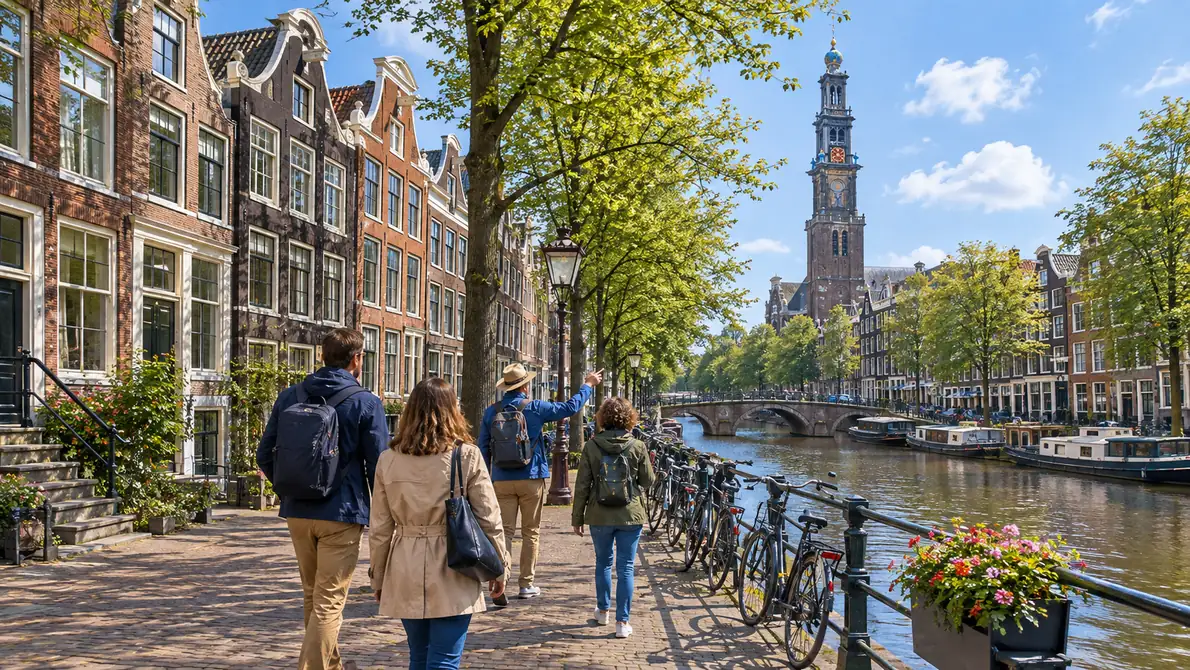
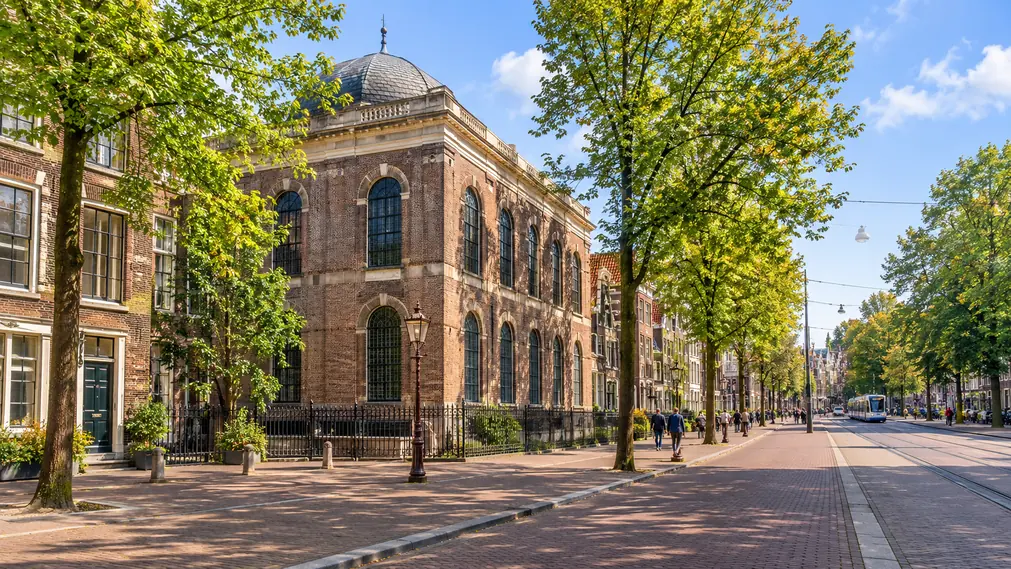
Hear the story where it happened: a specialist guide, the Prinsengracht and the Jewish Quarter, in one or two hours.
Check dates for the small-group Anne Frank walkHow did Anne Frank hide for two years?
By keeping to a strict routine of silence. During office hours the warehouse workers below did not know about them, so the people in hiding moved in socks, spoke quietly and waited for the evening.
The Anne Frank House reconstructs a typical weekday like this:
- 6:45 the alarm, the bathroom in turns, the blackout screens taken off the windows.
- 8:30 the warehouse staff arrive below: the riskiest half hour of the day, before the office helpers come in at 9:00. Mornings are for reading and study.
- 12:30 to 13:45 the workers go out for lunch. Kleiman, Kugler and Bep Voskuijl come up to eat, Miep Gies keeps watch in the office, and at 13:00 the radio goes on for the BBC news.
- 17:45 Bep leaves, the building is empty, and the eight can move through the whole house.
- Evening chores, reading and the radio, then the windows are blacked out for the night.
Sundays had their own rhythm of washing and cleaning. Anne studied, read and wrote, and her diary became the place where she could say what she could not say aloud in a few crowded rooms.
How long did Anne Frank hide before getting caught?
761 days: from 6 July 1942 until 4 August 1944, when the police raided the building. Nobody knows for certain why they came.
On Friday 4 August 1944, between about 10:30 and 11:00, police arrived at Prinsengracht 263. The officer in charge was Karl Josef Silberbauer of the SS. By about 13:00 the eight people in hiding and the helpers Victor Kugler and Johannes Kleiman had been taken away. Miep Gies and Bep Voskuijl went up afterwards, gathered Anne's scattered diary papers and kept them safe.
Why did they betray Anne Frank? It is not known whether anyone did. No documents about the raid survive, and the Anne Frank House says no theory has been proven, including a widely publicised claim from 2022. In 2016 its own research raised the possibility that the raid had other causes, such as an investigation into illegal work or ration coupons.
What happened to the people in hiding?
They were deported. Of the eight, only Otto Frank survived. Anne and Margot died in Bergen-Belsen in February 1945, according to research by the Anne Frank House; the exact date is unknown.
On 8 August 1944 the eight were taken to the Westerbork transit camp in the north-east of the Netherlands. On 3 September they were put on the last transport from Westerbork to Auschwitz, with more than a thousand other Jewish prisoners. In early November 1944 Anne, Margot and Auguste van Pels were moved to Bergen-Belsen in Germany.
- Hermann van Pels was murdered in the gas chambers of Auschwitz-Birkenau in October 1944.
- Fritz Pfeffer died on 20 December 1944 in Neuengamme, according to the camp records.
- Edith Frank died in Auschwitz-Birkenau on 6 January 1945.
- Margot and Anne contracted typhus in Bergen-Belsen, where conditions were unbearable, and died in February 1945, Margot first. Anne was 15.
- Auguste van Pels died in April 1945.
- Peter van Pels died in Mauthausen on 10 May 1945, five days after the camp was liberated.
- Otto Frank was liberated in Auschwitz on 27 January 1945 and returned to Amsterdam on 3 June 1945.
Her friend Hannah Goslar spoke with Anne in Bergen-Belsen in February 1945, shortly before Anne died. Anne and Margot were buried in a mass grave at Bergen-Belsen; a memorial stone for the sisters stands on the former camp grounds.
What happened to Anne Frank's diary?
Miep Gies kept the papers and gave them to Otto Frank after the war. He published the diary in 1947 as "Het Achterhuis", and it has since been translated into more than 70 languages.
Anne received the diary, the red-checked one now in the museum, for her 13th birthday on 12 June 1942, a few weeks before the family went into hiding. When it was full she went on in notebooks. In March 1944 a radio appeal from London asked people to keep their war diaries, and Anne began to rewrite hers as a book, on 215 loose sheets, from 20 May 1944. Her last diary entry is dated 1 August 1944, three days before the arrest. No final words of hers are recorded.
What was removed from Anne Frank's diary? Anne cut passages herself when she rewrote it, about Peter, her mother, her body and her period. Otto Frank compiled the published text from both versions and left out further candid passages, which later editions restored. In 2018 researchers read two pages she had pasted over in 1942: some jokes and notes on sex education, the curiosity of a teenager. Was Anne Frank LGBTQ+? Her diary records a teenager's curiosity about her body, love and attraction; in rewriting it she removed most of these passages, and the Anne Frank House does not label her.
The book reached the stage and the screen. Otto Frank asked Audrey Hepburn, born in 1929 like Anne, to play her in the 1959 film; she declined, saying she felt too old and not skilled enough, and noted how close her own wartime youth in the occupied Netherlands had been to Anne's (Wikipedia).

Walk the route the family took to the hiding place, hear extracts from the diary on the way, then see the Annex furnished in virtual reality.
Explore the Last Walk and VR Annex tour Tour detailsIs the Secret Annex still standing, and who owns the Anne Frank House?
Yes, the Annex still stands and is part of the museum route. The building is run by the Anne Frank House, an independent foundation in Amsterdam.
After the war the building was set to be demolished for a factory. Public support grew as the diary became known, the company that owned the site donated the building in 1957, the Anne Frank House foundation was set up the same year, and the museum opened on 3 May 1960 with Otto Frank present. At his wish the rooms stayed empty, as they were after the war. You still see the picture wall in Anne's room, the marks of the girls' heights and Otto's map of Normandy, and the original diary is on display in a special showcase.
Where is Anne Frank's real diary now? In that showcase. It belongs to the Dutch State and is on permanent loan to the museum. The copyright in the text is held by the Anne Frank Fonds in Basel, which Otto Frank founded in 1963. Anne Frank would have been 97 on 12 June 2026, and the museum marked her birthday that day. More than a million people visit every year; tickets are sold only on annefrank.org (how the tickets work).
Two and a half hours on the family's route, then the furnished Secret Annex in virtual reality.
Check dates for the Last Walk and VR Annex tourFrequently asked questions
Was Anne Frank 15 or 16 when she died?
She was 15. Anne was born on 12 June 1929 and died in Bergen-Belsen in February 1945, according to research by the Anne Frank House; the exact date is unknown.
Is any of Anne Frank's family still alive?
Anne and Margot had no children, and Otto was the only survivor of the family. Relatives on Otto's sister's side include the sons of Anne's cousin Buddy Elias, who died in 2015.
Did Anne Frank ever marry?
No. She died at 15. Her friends Hannah Pick-Goslar (died 2022) and Jacqueline van Maarsen (died 2025) knew her personally.
How old would Anne Frank's dad be today?
Otto Frank was born on 12 May 1889, so he would have been 137 in 2026. He died in 1980, aged 91.
Ready to book
Choose your tour
Free cancellation up to 24 hours before on every option. Prices are from-prices in USD and move with the season.
Anne Frank's Last Walk & VR Annex Tour
- English-speaking guide
- The family's walk to the hiding place
- Virtual reality tour of the Secret Annex
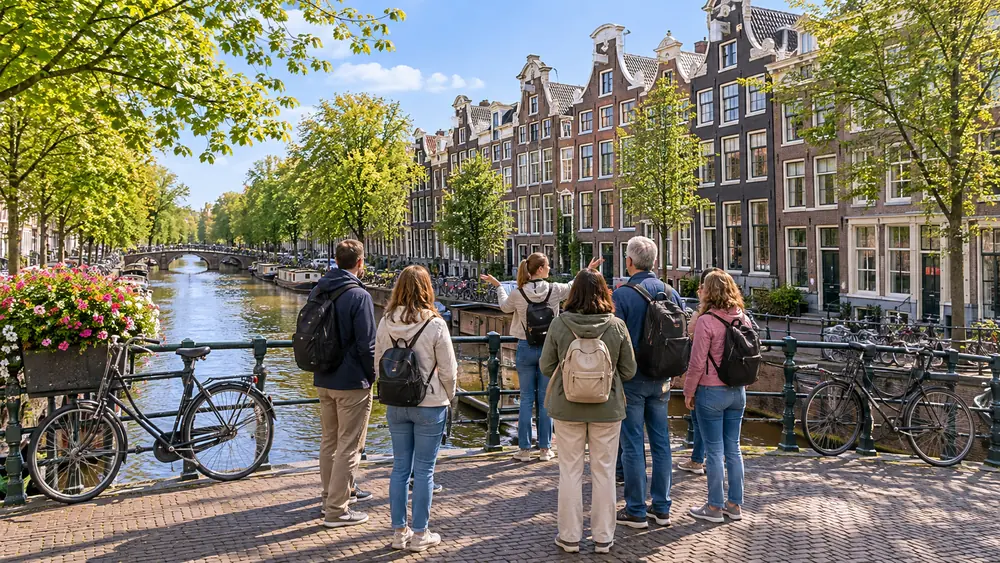
Anne Frank Small-Group Walking Tour
- Anne Frank specialist guide in your language
- One- or two-hour walking route
- Small group, or private on two hours
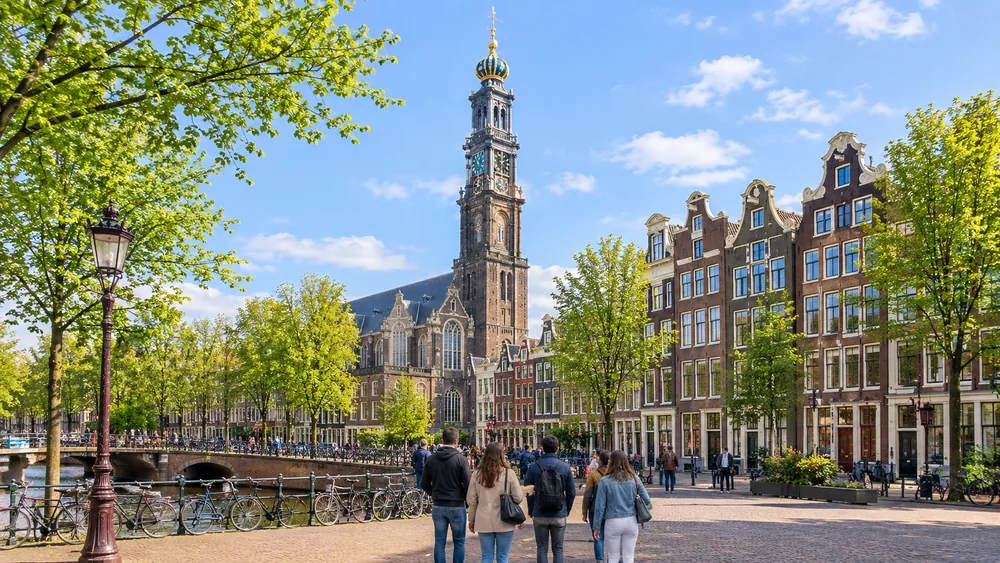
Anne Frank Guided Walking Tour
- Guide in English, German, Italian, Spanish or French
- Two-hour walking route
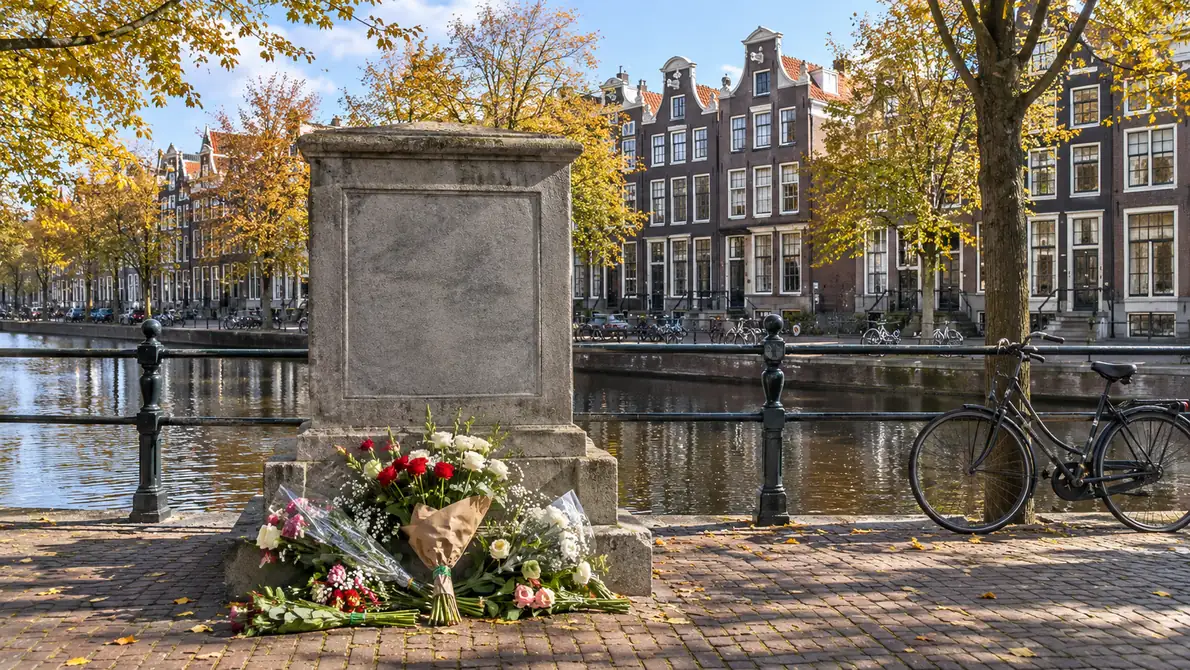
- Start at the Anne Frank monument